4 hr
Saigon Cooking Class & Ben Thanh Market Tour with Chef
Master Vietnamese cuisine at your own station, then explore the iconic Ben Thanh wet market
Reserve
Hand-picked by our editors — only the best 5 experiences from 23 reviewed.
Verified partners for every tour, free cancellation where available, and instant confirmation on every booking.
4 hr
Master Vietnamese cuisine at your own station, then explore the iconic Ben Thanh wet market
Reserve
3 hr
Master authentic Vietnamese recipes in a local kitchen, preparing traditional dishes from scratch.
Reserve
3 hr
Learn authentic Vietnamese recipes in an intimate setting, then enjoy the delicious meal you've prepared.
ReservePrices from verified partners. Availability updates in real time at checkout. Free cancellation policies apply where shown.
The landmarks, rooms, and views travelers on this tour remember — all visible on a single visit.
Master the complex aromatics of authentic Vietnamese soup in this area.
Learn the delicate process of handling rice noodles in this workshop zone.
Discover the fresh mint, coriander, and Thai basil used in our dishes.
Explore the essential star anise and cinnamon used for your pho cooking class ho chi minh.
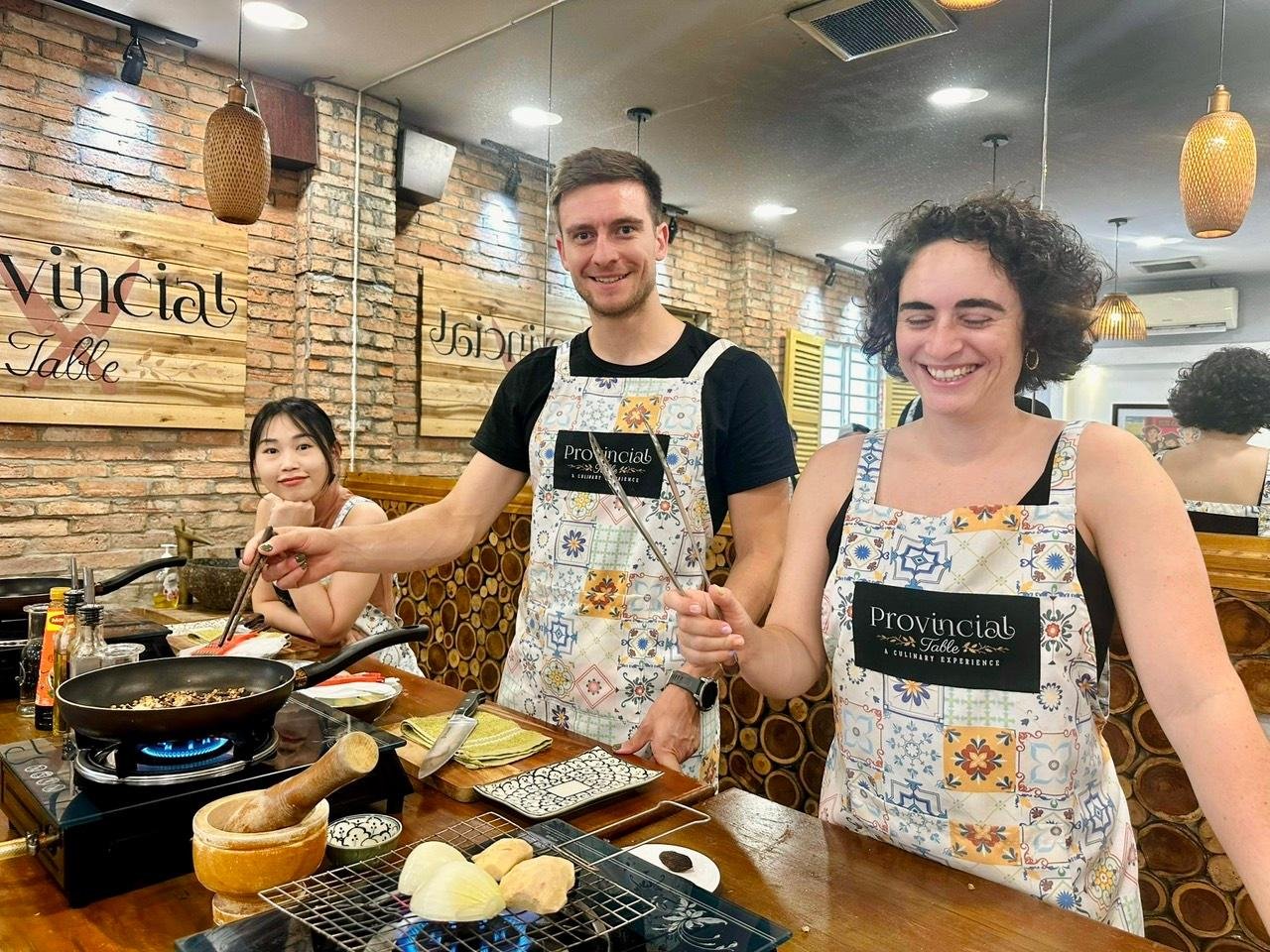
The primary space for your Vietnamese Cooking Class demonstration and preparation.
Professional schools offer a structured culinary environment, whereas private home-hosted lessons provide deeper cultural immersion; choose the former for technique and the latter for a personal narrative.
| Feature | Top pick Saigon Cooking Class | Private Home-Hosted Experience |
|---|---|---|
Environment |
Professional kitchen studio | Private residential kitchen |
Class Size |
Group based | One-on-one or small group |
Curriculum Structure |
Formal lesson plan | Flexible and conversational |
Authenticity Focus |
Standardized regional recipes | Traditional family heritage |
Customization Level |
Set menu options | Highly personalized ingredient choice |
| See tickets → |
Verdict: If you seek professional-grade pho cooking class ho chi minh tours, the formal school is ideal, whereas the private home-hosted phoenix cooking class ho chi minh tickets offer a more intimate, local interaction, and booking the pho cooking class ho chi minh tour ensures a reliable foundation in broth preparation.
Choose your ticket, select your date, and reserve in under two minutes. Secure checkout handled by our verified partner.
Instant confirmation by email, with a mobile voucher you can save offline. No printing, no queuing at a collection desk.
Arrive at the entrance, show your voucher on your phone, and walk in. Most tickets include priority or skip-the-line access.
Practical details for your visit straight from our verified partners — hours, access, rules, and how to get there.
80/1 Nguyen Trai Street
Arrive before your session start time.
The most direct method to reach the pho cooking class ho chi minh location in District 1.
Accessible if staying in central District 1 near Nguyen Trai Street.
Casual and comfortable clothing is recommended for this pho cooking class ho chi minh. Closed-toe shoes are advised for safety in the kitchen environment.
Personal belongings can be stored in designated areas during the Vietnamese Cooking Class session. Large luggage is not recommended due to limited floor space.
Photography is encouraged throughout the pho cooking class ho chi minh. Please be respectful of other participants and the chef during demonstrations.
The venue is located on Nguyen Trai Street and features standard kitchen workstations. Please contact the operator in advance regarding specific mobility requirements.
Mobile phones may be used for photos, but please keep them away from food preparation surfaces. Avoid long calls to maintain a focused environment for your pho cooking class ho chi minh.
The pho cooking class ho chi minh is suitable for families with older children interested in culinary arts. All participants must hold a valid registration for the Vietnamese Cooking Class.
All ingredients for the Vietnamese Cooking Class are provided. Participants will consume the meals prepared during the pho cooking class ho chi minh.
Pets are strictly prohibited inside the facility. Only certified service animals may be permitted with prior notification.
Arrival before your scheduled session start is required for the Vietnamese Cooking Class. The address is 80/1 Nguyen Trai Street, District 1, Ho Chi Minh City, Vietnam.
Best time to go, insider tips, nearby landmarks, and the cancellation fine print — flip through to skim what matters to you.
How crowds, weather, and events shift across the year.
March to May offers warm weather and fewer crowds for your pho cooking class ho chi minh session.
June to August is the rainy season, providing a cool indoor activity for your Vietnamese Cooking Class.
September to November features pleasant temperatures, ideal for a pho cooking class ho chi minh tour.
December to February is the dry season, making it a popular time for a pho cooking class ho chi minh tour.
Small details that turn a good visit into a great one.
Secure your pho cooking class ho chi minh tickets online to ensure availability.
Engage with your instructor during the Vietnamese Cooking Class for deep culinary insights.
Plan for traffic in District 1 when commuting to your pho cooking class ho chi minh.
Non-bookable sights within a short walk — free to visit, easy to pair.
A historic marketplace perfect for exploring local spices and produce.
A sobering look at history located a short distance away.
An iconic building showcasing mid-century architecture.
A green space ideal for a post-class walk near your Vietnamese Cooking Class.
Flexible, no hidden fees.
Cancellations made within the specified window are subject to the terms of the operator. The entrance fee of 840,000 VND is typically non-refundable if canceled on the day of the class.
Hand-picked options within walking distance — pick a district for vibe, or a specific hotel for convenience.
Pho emerged in early twentieth-century Hanoi as a street vendor's gamble — beef bones simmered overnight with charred ginger, star anise, and cinnamon, then ladled over fresh rice noodles at dawn. The dish traveled south after 1954, arriving in Saigon with northern migrants who adjusted the recipe to southern tastes: sweeter broth, wider noodles, and a forest of herbs on the side. By the nineteen-seventies, pho had become the de facto breakfast of a reunified Vietnam, its simmering pots a constant in every district from Cholon to District 1. Today, pho stands as the country's most recognized culinary export, yet its construction remains a study in restraint — clarity of broth, precise doneness of noodle, and the eater's final calibration of lime, chili, and basil. A pho cooking class in Ho Chi Minh City reverses the anonymity of the street bowl. Participants source raw ingredients at Ben Thanh or a neighborhood wet market, selecting knuckle bones, brisket, and the specific rice-noodle width that defines southern pho. The instructor — often a third-generation vendor or culinary-school graduate — demonstrates the charring of onion and ginger over open flame, a step that imparts the broth's signature caramel depth without added sugar. Star anise, cinnamon bark, coriander seed, and black cardamom go into a spice sachet; timing and temperature separate a clean, amber broth from a cloudy one. Rice noodles are either hand-cut from steamed batter or purchased fresh, then blanched for fifteen seconds — overcooking turns them to paste. The final bowl is a composition exercise: brisket and tendon, noodles, broth, then a plate of sawtooth coriander, Thai basil, lime wedges, bird's-eye chili, and hoisin for the eater to adjust. Vietnamese cooking classes in Saigon typically run three to four hours and include a full meal at the end, often a four-course progression that places pho alongside spring rolls, caramelized clay-pot fish, or green papaya salad. Some programs begin with a guided market walk, where participants learn to distinguish varieties of rice noodle, identify fish-sauce grades by protein content, and negotiate prices in Vietnamese. Classes are held in private homes along the Sanh Canal, colonial-era villas in District 3, or purpose-built cooking studios near Nguyen Trai Street. Small-group formats — typically six to twelve participants — allow individual attention at the stove, and recipes are provided in both metric and volume measurements for replication at home. The cooking class model has grown in tandem with culinary tourism; by 2026, more than thirty operators in Ho Chi Minh City offer daily sessions, yet quality varies sharply based on instructor credibility and ingredient sourcing. The pho cooking class has become a gateway to understanding Vietnamese flavor philosophy, which privileges balance — sweet, sour, salty, bitter, umami — over isolated intensity. Participants leave with a functional grasp of fish sauce, a respect for the time required to render collagen into silk, and the recognition that a bowl of pho is not a recipe so much as a negotiation between cook and eater. The dish remains a living form, absorbing regional inflections and personal adjustments while retaining its elemental structure: broth, noodle, meat, herb. That tension between fixity and variation is what the cooking class attempts to teach, one simmering pot at a time.

"A bowl of pho is not a recipe so much as a negotiation between cook and eater."
A step-by-step walkthrough of the visit — what you'll see, how long each stage takes, and the details that matter.
You meet your instructor at 08:00 on Nguyen Trai Street, then walk three blocks to a wet market where vendors arrange herbs in green towers and butchers split beef shanks on wooden blocks. Your group selects knuckle bones, brisket, and a bundle of flat rice noodles still warm from the steamer. Back at the cooking studio, you char onion halves and ginger knobs over a gas flame until their skins blacken and their sugars caramelize. The instructor fills a stockpot with cold water, adds the bones, and brings it to a rolling boil; you skim the gray foam that rises, then lower the heat to a bare simmer. Star anise, cinnamon sticks, coriander seeds, and cardamom pods go into a muslin sachet and sink into the broth, which will cook for the next ninety minutes. While the broth reduces, you prepare garnishes: Thai basil leaves stripped from stems, sawtooth coriander chopped coarse, lime wedges, and sliced bird's-eye chili arranged on a plate. The instructor demonstrates how to blanch rice noodles — fifteen seconds in boiling water, then immediate transfer to a cold-water bath to halt cooking. You slice cooked brisket against the grain into paper-thin ribbons, then arrange them in a bowl. The broth is strained through cheesecloth, its amber clarity a measure of technique. You ladle it over noodles and meat, the heat cooking thin slices of raw beef eye-round in seconds. You add lime juice, fish sauce, and chili to taste, then lift the first spoonful — the broth is clean, faintly sweet, and layered with spice warmth that builds rather than burns.
The facility is open daily from 08:00–18:00 for your pho cooking class ho chi minh.
Yes, the entrance fee of 840,000 VND is per person and covers the full Vietnamese Cooking Class including the meal.
You can book your pho cooking class ho chi minh tickets via the official site at https://saigoncookingclass.com.
You should arrive before your session start time, between 08:00–18:00, at 80/1 Nguyen Trai Street.
Yes, families are welcome at the pho cooking class ho chi minh, provided children can participate safely in the kitchen.
Cancellation terms are outlined by the operator; please note the 840,000 VND fee is standard for the Vietnamese Cooking Class.
Yes, the pho cooking class ho chi minh is located in District 1, close to major landmarks like Ben Thanh Market.
No, all ingredients for the Vietnamese Cooking Class are provided as part of your experience.
Yes, you are encouraged to photograph your experience during your pho cooking class ho chi minh.